
The natural choice for cleaning delicate garments in an environmentally friendly way
Liquid CO2 dry-cleaning technology

A cost-effective initiative
The CO2 system is an investment that soon pays for itself through very low operational costs. Each load requires very little CO2 solvent and energy costs are considerably lower than traditional dry-cleaning technologies. The CO2 process also ensures quick cleaning times. In fact, garments are ready for finishing the second they come out of the machine. More loads can be processed each day and, as a result, improve the productivity of the operation.
And the results are excellent
CO2 process is particularly effective for suede, leather, wool and silk. Low temperatures and mild agitation ensure a gentle cleaning process. This gives flexibility to mix colors and materials quite freely. For example, you don’t have to wait for garments of a specific color to pile up to process a batch.

The virtues of simplicity
The CO2 machine is simple to operate and easy to maintain, no filter to clean and easy handling of the waste. All you have to do is open a valve to collect the dirt and residue that has accumulated in the distiller. In the morning, you press a single button to start the machine’s self-cleaning process. It’s that simple. And the CO2 supplier comes regularly to change the tank. Talk about convenience!
CO2 is a safe and smart choice
- Exists naturally in the atmosphere
- Non-toxic, if not inhaled in high concentrations
- Non-flammable
- Odorless
- Tasteless
- Colorless
- Good solvent for fats and dirt
- Water-soluble
Take a closer look at the innovative CO2 process
The natural next step in the evolution of your operation
At pressures of 50-60 bars, CO2 becomes a liquid that is a highly effective, recyclable solvent for cleaning garments.
A closed system
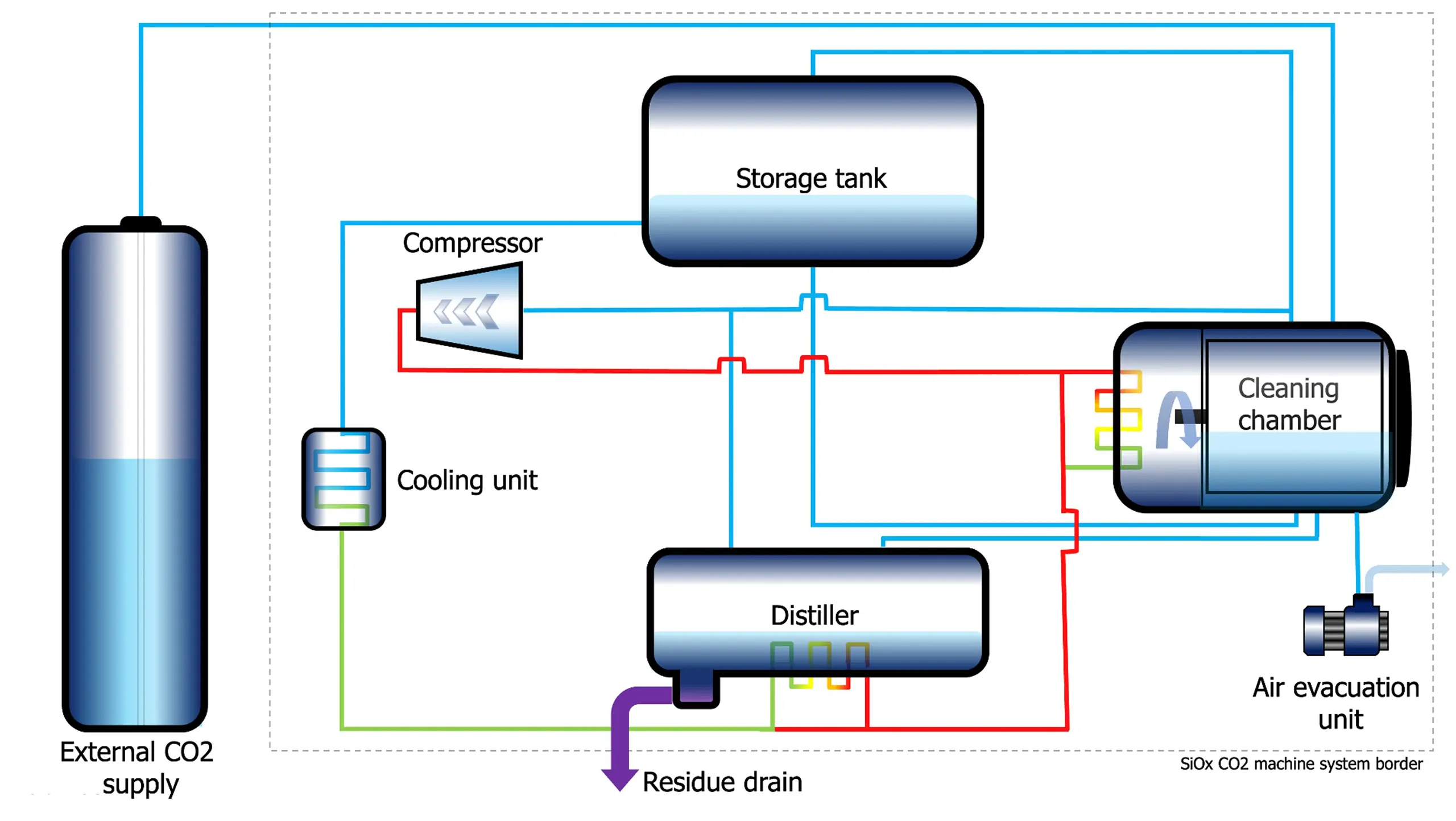
The CO2 dry-cleaning machine is based on a closed process that distills and recycles used liquid CO2. Only a small amount of gas is released into the atmosphere-this occurs when removing garments from the cleaning chamber. CO2 stored in an external tank compensates for this loss.
Loading
After loading garments into the chamber and closing the door, the system removes all air from the chamber. Gaseous CO2 from the top of the storage vessel then pressurizes the chamber. When the pressure in the storage vessel and the chamber is equalized, liquid CO2 from the bottom of the storage vessel flows into the chamber.
Cleaning
The cleaning sequence is performed in a rotating basket partially filled with liquid CO2. Because the temperature during the cleaning sequence does not exceed 25°C, garments are not damaged by high temperatures.
Rinsing
One and two-bath processes can be performed in the machine. The second bath is a rinse sequence similar to the cleaning sequence, but with a shorter duration.
Distilling
After each bath, the CO2 is distilled and condensed into liquid form before entering the storage tank. This ensures that the CO2 is pure and free from contamination. Distillation occurs during the cleaning sequences, with no addition to overall process time.
Emptying and drying
When the cleaning and rinsing sequences are completed, a compressor reduces the pressure inside the cleaning chamber to a minimum. The door can now be opened, releasing the remaining CO2 into the atmosphere. The garments are now completely dry and ready for final finishing.
Frequently asked questions
1
Does CO2 cleaning contribute to the greenhouse effect?
No. The process is environmentally neutral. It simply “borrows” existing CO2 from the atmosphere.
2
How does the cleaning power of the liquid CO2 solvent compare with conventional cleaning fluids?
The cleaning power is similar to that of hydrocarbon.
3
Are pre-spotters and detergents needed?
The CO2 system requires pre-spotters in the same way as traditional solvent cleaning. Pre-spotters and detergents have been developed specifically for the CO2 process. Because the temperature is low during the entire process, stains do not become fixed in the garment-making post-spotting easy.
4
Does the process cause shrinkage?
No. The dimensional stability of cleaned garments is similar to other solvent processes.
5
Does the process cause color bleeding?
Considerably less than conventional processes because process temperatures are lower (never above 25°C) and the solvent is less aggressive.
6
Is the pressure safe?
Yes. The pressure is low (50-60 bar) compared with standard pressurized gas bottles (200-300 bar). The machine is designed to handle the required pressure.
7
Is the sediment from distillation a hazardous waste?
No. The sediment consists only of removed dirt and fully biodegradable detergents. There is no solvent left in the sediment.
8
Does the entry of water or other solvents into the CO2 affect the process?
Water and solvents (as well as dirt, oil, detergents, etc.) that enter the machine are simply removed from the CO2 during distillation.
9
How large is the externa! tank? What is the refilling rate?
Tank size is determined by how frequently you use the machine. The CO2 supplier’s truck refills the tank according to your requirements. A normal filling rate is every 3-4 weeks.
10
Are there special finishing requirements?
No. They are the same as with traditional dry-cleaning.
With respect for the environment
Developing environmentally-friendly laundry solutions is an important priority for us. And our CO2 dry-cleaning process is a perfect example. In fact, it is a natural next step toward a cleaner environment and a more economical way of dry-cleaning garments. As a solvent, liquid CO2 is environmentally neutral and does not contribute to the greenhouse effect. It is simply borrowed from the atmosphere.